


 Sever’s Disease in Children and Young Athletes: How to Manage Heel Pain and Return to Sport
Author: Pierce McGill | Lead Youth Academy Coach
In youth sport, running, jumping and changing direction are all part of the game. But what happens when your child starts complaining of heel pain during training or after football, GAA or rugby matches?
One possible cause is Sever’s disease, also known as calcaneal apophysitis. It is a common cause of heel pain in children and growing athletes, particularly those involved in sports with repeated running and jumping.
For parents, it can be frustrating to see their child struggle to train or compete. Should they stop playing altogether, or is there a way to keep them active while managing their symptoms?
The key is understanding how to manage training load, maintain appropriate physical activity and gradually rebuild tolerance to sport.
Click here to explore the Youth Athlete Academy
What Is Sever’s Disease?
Sever’s disease involves irritation of the growth area at the back of the heel bone, where the Achilles tendon attaches to the calcaneus bone.
During growth, this area can become sensitive to the repeated forces associated with running and jumping. Symptoms often include:
- Heel pain during or after sport.
- Tenderness around the back of the heel.
- Discomfort when running, jumping or pushing off the foot.
- Symptoms that improve with rest but return when activity increases.
It commonly affects active children and adolescents during their growing years.
Growth, training demands and individual tolerance can all contribute to symptoms. However, not every case of heel pain is Sever’s disease, so persistent or concerning symptoms should be assessed by an appropriate healthcare professional.
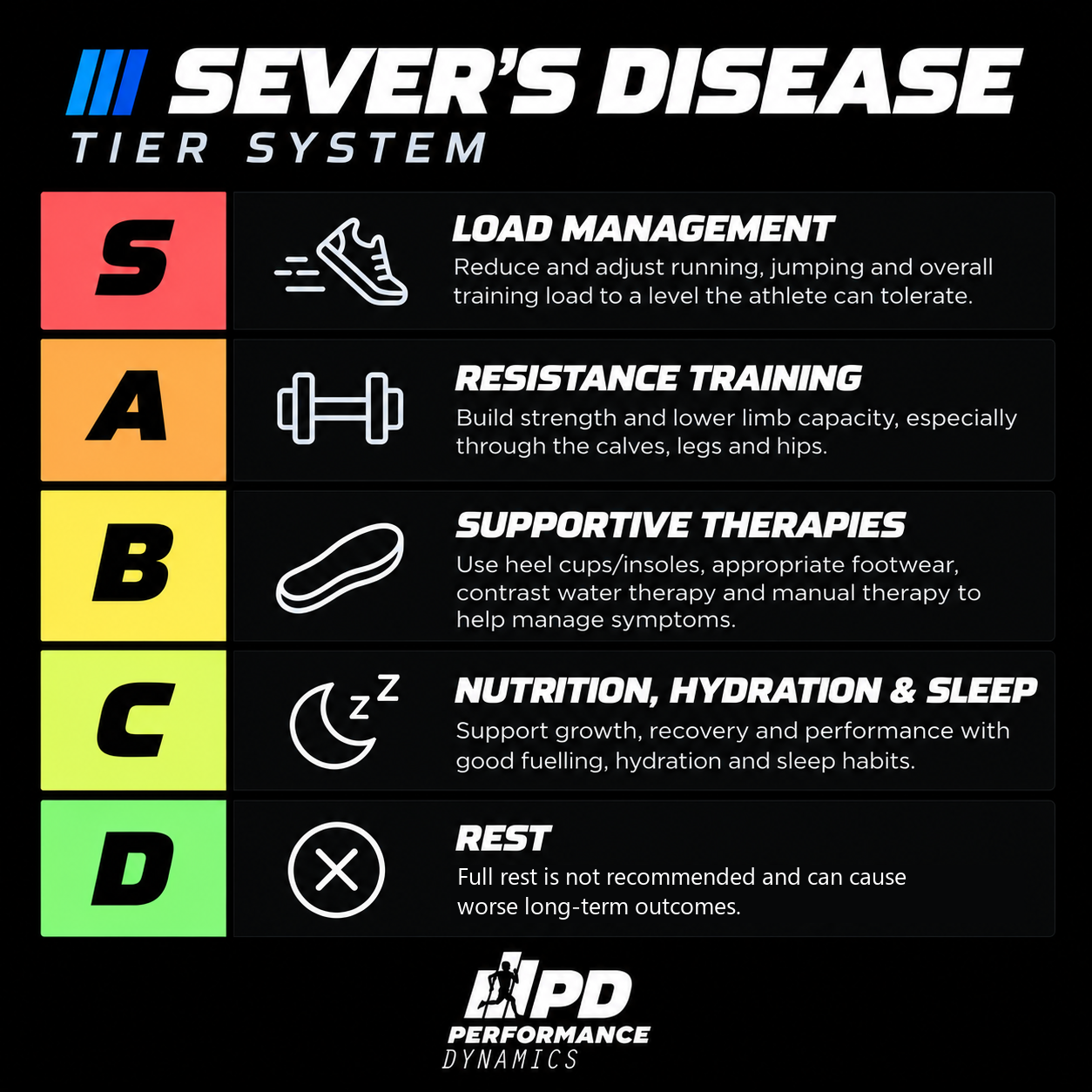
Sever’s Disease Tier System
- S: Load management. Reduce and adjust running, jumping and overall training load to a level the athlete can tolerate.
- A: Resistance training. Build strength and lower limb capacity, especially through the calves, legs and hips.
- B: Supportive therapies. Use heel cups/insoles, appropriate footwear, contrast water therapy and manual therapy to help manage symptoms.
- C: Nutrition, hydration and sleep. Support growth, recovery and performance with good fuelling, hydration and sleep habits.
- D: Rest. Full rest is not recommended and can cause worse long-term outcomes.
Load Management: Keep Them Active, Adjust the Demands
One of the biggest mistakes when managing Sever’s disease is treating activity as an all-or-nothing decision.
Complete rest is not always necessary. Instead, the aim is to reduce activities that aggravate symptoms while maintaining physical activity that the athlete can tolerate.
Consider your child’s total weekly load, including club training, matches, school sport, gym sessions and informal play. The heel responds to the combined demands of these activities, not just one training session.
Use the 24-Hour Response Rule
Monitor how your child’s heel feels during activity, afterwards and the following morning.
GREEN Symptoms remain minimal, walking is normal and there is no meaningful increase in pain the following morning. Continue appropriately modified activity.
AMBER Pain increases or lingers after training. Reduce running, jumping or other aggravating activities.
RED Pain is severe, walking is affected or the athlete develops a limp. Stop the provoking activity and seek appropriate advice.
These are practical monitoring guidelines rather than validated diagnostic thresholds. Pain should not be used in isolation, and young athletes should not be encouraged to push through worsening symptoms.
Exercise Prescription: Rebuild Strength and Capacity
Reducing aggravating activities can help settle symptoms, but the longer-term goal is to rebuild the athlete’s ability to tolerate the demands of sport.
Exercise should progress according to symptoms, movement quality and individual tolerance.
1. Maintain Comfortable Movement
Initially, reduce painful impact activities and maintain suitable alternatives.
Examples include cycling, swimming, gentle ankle mobility and comfortable calf contractions.
2. Build Strength
As symptoms settle, gradually introduce exercises that develop calf and lower-limb strength.
Examples include:
- Standing and bent-knee calf raises.
- Split squats and step-ups.
- Hip and trunk strengthening exercises.
3. Reintroduce Impact
When strength exercises are well tolerated, progressively introduce more demanding activities.
Examples include skipping, low-level jumping, hopping and landing exercises.
4. Prepare for Sport
Gradually progress towards jogging, sprinting, changing direction and sport-specific drills.
If symptoms increase during exercise or flare up the following morning, the training load may need to be reduced.
Research supports conservative approaches to managing Sever’s disease, although the evidence does not establish one universally superior treatment for every child.
Return to Sport with Sever’s Disease: Progress Gradually
One of the most common questions parents ask is, “When can my child play again after severs?”
The answer depends on how well they tolerate progressively more demanding activity, rather than simply how much time has passed.
A practical return-to-sport progression is:
- Normal walking without a limp.
- Comfortable strength exercises.
- Low-impact conditioning.
- Gradual return to running.
- Progressive sprinting and acceleration.
- Jumping and changes of direction.
- Full training.
- Return to competition.
Progression should not be automatic. Each stage should be well tolerated before the next is introduced.
Supportive footwear, insoles or heel cups may also help some athletes manage symptoms, but they are not a guaranteed solution. Persistent pain or difficulty progressing warrants professional assessment.
Nutrition, Recovery and Lifestyle
Young athletes are still growing, so recovery involves more than modifying exercise.
A few simple priorities can support their general development and recovery:
- Nutrition: Provide enough energy through regular, balanced meals and snacks.
- Protein: Include suitable sources throughout the day to support growth and tissue maintenance.
- Bone health: Ensure adequate calcium and vitamin D through diet and appropriate healthcare advice.
- Hydration: Encourage regular fluid intake throughout the day.
- Sleep: Prioritise consistent sleep routines to support growth and recovery.
These habits support general health but do not replace appropriate load management or clinical care.
Practical Recommendations for Parents and Coaches
Managing Sever’s disease works best when everyone supporting the athlete communicates.
For parents:
- Monitor symptoms during activity and the following morning.
- Consider the total weekly training load.
- Encourage appropriate recovery, nutrition and sleep.
- Avoid rushing the return to competition.
For coaches:
- Modify running and jumping when necessary.
- Maintain skill development through suitable alternatives.
- Communicate training demands with parents and support staff.
For strength-and-conditioning coaches:
- Maintain tolerable strength and conditioning work.
- Progress calf strengthening and impact gradually.
- Adjust exercises according to symptoms and recovery.
If heel pain is persistent, worsening or affecting normal walking, seek assessment from an appropriate healthcare professional. Severe pain, significant swelling, fever, pain following substantial trauma or an inability to bear weight requires prompt medical attention.
Key Takeaways for Parents
- Sever’s disease is a common cause of heel pain in growing athletes.
- Complete rest is not always necessary; painful activities may need to be modified.
- Monitor symptoms during activity and the following morning.
- Progress from strength exercises towards running, jumping and sport-specific demands.
- Nutrition, sleep and communication between parents and coaches support recovery.
- Return to sport should be guided by symptoms and function, not a fixed timeline.
Want to Help Your Child Stay Active, Strong and Confident in Sport?
Heel pain can be frustrating, but it does not necessarily mean putting all physical development on hold.
At Performance Dynamics, our Youth Athlete Academy focuses on helping young athletes build strength, coordination and physical capacity through structured, age-appropriate training.
Where appropriate, training can be adapted to support ongoing development while an athlete manages symptoms and works towards returning to sport, alongside any necessary healthcare support.
Click here to explore the Youth Athlete Academy
Sever’s Disease: Frequently Asked Questions
What causes Sever’s disease?
Sever’s disease involves irritation of the growth area at the back of the heel bone, where the Achilles tendon attaches. Growth, training demands and individual tolerance can all contribute, particularly in sports with repeated running and jumping.
What age does Sever’s disease affect?
It commonly affects active children and adolescents during their growing years, typically between around 8 and 14 years of age.
What are the symptoms of Sever’s disease?
Common symptoms include heel pain during or after sport, tenderness around the back of the heel and discomfort when running, jumping or pushing off the foot. Symptoms often improve with rest but return when activity increases.
Is Sever’s disease serious?
Sever’s disease is a common and usually temporary cause of heel pain in growing athletes. However, not every case of heel pain is Sever’s disease. Severe pain, significant swelling, fever, pain following substantial trauma or an inability to bear weight requires prompt medical attention.
What can I do to help my child with heel pain?
Monitor symptoms during activity and the following morning, consider their total weekly training load and reduce the activities that aggravate the heel while keeping them active with suitable alternatives. If heel pain is persistent, worsening or affecting normal walking, seek assessment from an appropriate healthcare professional.
Should my child stop playing football or other sports with Sever’s disease?
Not necessarily. Activities that provoke pain may need to be reduced or temporarily stopped, while other forms of exercise may remain suitable.
What exercises and stretches help Sever’s disease?
Early on, gentle ankle mobility and comfortable calf contractions may be suitable. As symptoms settle, exercises such as standing and bent-knee calf raises, split squats and step-ups can help rebuild strength. Exercise should progress according to symptoms, movement quality and individual tolerance.
Do heel cups, insoles or shoes help Sever’s disease?
Supportive footwear, insoles or heel cups may help some athletes manage symptoms, but they are not a guaranteed solution. They work best alongside load management and a gradual return to sport.
How long does Sever’s disease last?
Recovery varies between athletes. Symptoms may settle over weeks or take longer, particularly if activity repeatedly aggravates the heel.
Can my child still do strength training with Sever’s disease?
Potentially, yes. Appropriately selected and supervised exercises can help maintain physical development while reducing painful impact activities.
When can my child return to matches after Sever’s disease?
They should progressively tolerate running, sprinting, jumping, changes of direction and full training without a significant flare-up before returning to competition.
Click here to explore the Youth Athlete Academy
References
James, A.M., Williams, C.M. and Haines, T.P. (2013). ‘Effectiveness of interventions in reducing pain and maintaining physical activity in children and adolescents with calcaneal apophysitis (Sever’s disease): a systematic review’. Journal of Foot and Ankle Research, 6, Article 16. https://doi.org/10.1186/1757-1146-6-16.
Kothari, E.A. et al. (2015). ‘Treatment of Calcaneal Apophysitis: Wait and See Versus Orthotic Device Versus Physical Therapy: A Pragmatic Therapeutic Randomized Clinical Trial’. Journal of Paediatric Orthopaedics. PubMed.
StatPearls Publishing. Sever Disease (Calcaneal Apophysitis). NCBI Bookshelf.
This article is for educational purposes and does not replace an individual medical assessment or treatment plan.
 Other articles


